
Boom. Boom. Boom.
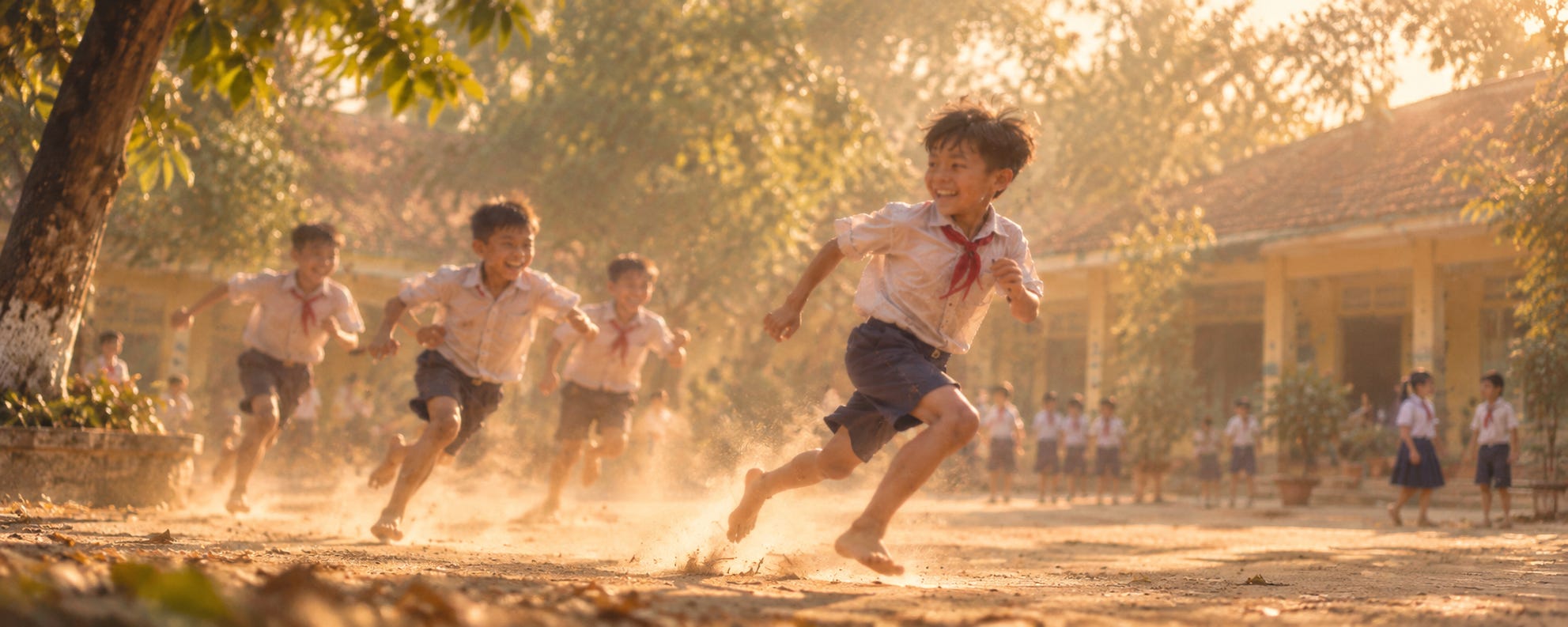
The school drum boomed, and every boy in my third-grade class ran outside.
Within seconds, we had split into two teams. One team ran. The other chased. A round was not over until every runner had been caught. Then we switched sides and started again.
Sometimes a round was over quickly. Sometimes it went on and on.
We ran barefoot around the school, trying to be a little faster, a little harder to catch. One boy might be behind me. Then two. Sometimes three. I would change direction, look for another way out, keep running.
And if everyone else on my team had already been caught while I was still free, I was no longer running only for myself. Every few seconds I stayed away kept my whole team in the game. I wanted to run faster, escape a little longer, do my part a little better.
By the time recess ended, we were drenched in sweat.
We never needed to tell one another, “That was so fun.” The satisfaction was already there on our faces.
Then the next recess came, and we went back to the same game.
Day after day. Month after month.
I think about that kind of joy more now that I am an adult.
I have more money now. More freedom. More choices. I can travel farther, try more things, decide for myself how I want to spend my time.
And a lot of my life is good.
But often it is just good.
Not the kind of good that made us run barefoot around a school until we were covered in sweat and still want to do the same thing again tomorrow.
For a while, I thought maybe the explanation was simple.
Maybe I just had less to worry about then. I was not running around the school while another part of my mind was thinking about a project I still had not finished, rent at the end of the month, or something waiting for me tomorrow.
Maybe I was simply more present.
Or maybe it was because those friendships were more familiar.
All of those explanations seemed possible.
But I still could not understand one thing:
Why did something so ordinary feel so alive?
The explanation I kept coming back to was presence.
When I thought about those recess games, I could not remember much distance between myself and what was happening. Once we started running, there was the person behind me, the open space ahead, the next turn, the simple need not to get caught. The game took over.
Maybe what I was remembering was flow.
I know that feeling from interval running now.
The pace is a little faster than what feels normal, fast enough that I cannot let my mind wander very far. If I slow down, the watch on my wrist tells me. At first I am working to stay on pace, but as the run goes on, the rhythm begins to carry more of the work for me.
My breathing falls into my stride. My arms and legs move with it. Pace, breath, movement stop feeling like separate things I have to keep checking and start becoming one continuous motion. I am no longer thinking about how to make each part work together. My body is already doing it. I am just running.
The ground moves underneath me and my whole body moves as one. Sometimes it feels less like running than gliding over the ground. Sometimes the rhythm becomes so smooth that it feels almost like dancing. The effort is still there, but I am no longer standing outside it, managing it. I am inside it. Whatever had been in my mind before the workout has fallen away, and the movement keeps carrying me forward.
So I had not lost my ability to become completely absorbed in what I was doing.
But when I put that state beside those recess memories, something still did not match.
The absorption was there. The same almost magical joy was not.
I started wondering if the people around me had something to do with it.
Not long ago, I went to a Vietnamese AI event in Mountain View. There were around a thousand people there, and almost everyone was Vietnamese. I came with one friend. Everyone else was a stranger.
Still, the room did not feel like a room full of strangers.
Before I had really talked to anyone, I already felt comfortable stepping in. I heard Vietnamese around me. The way people spoke and interacted felt familiar. I did not have to figure out how to enter the room or whether I had a place in it.
I started talking to people.
I asked questions, started conversations, shared more freely. My attention stayed with the people in front of me. I was curious about what they were saying, what I genuinely wanted to ask, what I wanted to understand. I spent much less time monitoring how I sounded.
It felt easy. Open. Connected.
I had felt almost the opposite in a small-group communication workshop in the United States.
There were five of us, and everyone was kind. No one showed impatience with me. But I could not always follow the conversation easily in English. Soon I was thinking about myself almost as much as I was listening to everyone else.
Am I slowing everyone down?
Am I receiving more from this group than I can give back?
Can I keep up?
Part of me was in the conversation. Another part was watching me inside it.
At Mountain View, I could give my attention to the people around me. In the workshop, part of that attention kept turning back toward myself.
Maybe the word I had been missing was belonging.
But when I put the feeling from Mountain View beside those recess games, they still did not feel the same.
The ease was there. The connection was there. The same almost magical joy was not.
The game had all of me. I was watching who was behind me, where I could turn, how much longer I could stay free. But I was also surrounded by people I already knew. I did not have to figure out how to enter the group or whether I had a place there.
I had a place there, and I was completely inside what we were doing.
Those two things had been sitting together so naturally that I had never thought to separate them.
Even as a child, it did not always feel this way. There were groups where I did not feel that I fit. Around them, I noticed myself more. Instead of simply playing, part of me was wondering whether I belonged there. The joy changed.
And that was the problem with calling this a childhood feeling.
I had felt this same kind of aliveness many times as an adult. One of the clearest memories came from my university years, when I often went with other students to do công quả, volunteer work at a Buddhist temple before large ceremonies.
Some of us worked in the kitchen. Others swept rooms, laid out mats, moved tables and chairs, or prepared the spaces for the ceremony. The monks and nuns showed us what needed to happen next. One task ended and another appeared. People moved in and out all day, each busy with something different, all of it moving toward the same preparation.
We could be busy from morning until evening. There was real responsibility in getting things ready properly.
But I do not remember spending those days waiting for the work to end.
I remember the energy of everyone moving around me, each person caught up in their own part of the work while still moving with the rest of the group. I could be completely occupied with whatever was in front of me without feeling separate from everything happening around me.
The work kept moving, and we moved with it. There was always something that needed my full attention. I did not have to stand outside the experience and ask myself whether I was enjoying it. I was simply in it.
Years after those barefoot games at school, there it was again.
Whatever this state was, childhood did not own it.
If I had felt this way many times as an adult, why had I spent so long remembering it as something that belonged to childhood?
What I had never noticed was how much had already been in place before the game even began.
We saw the same people every day and returned to the same games often enough that we got better together without trying to. We learned how one another moved, who was fast, who was hard to catch. All that repetition gave familiarity time to deepen until belonging became so ordinary that I barely noticed it was there.
The drum rang. We went outside. The others were there. The game was there.
That was enough to begin.
As an adult, those same conditions are still possible. They just no longer tend to come together on their own.
Friends may live farther apart. Calendars fill up. Work takes the same hours we might otherwise spend together. Even when people want to see one another, the timing and place have to work, and they have to keep coming back. One good afternoon is not enough for that kind of familiarity to become background.
What childhood had once bundled together had become separate things.
I still notice versions of that old structure in adult life. The same group runs together every week. Friends keep showing up to play pickleball or hike together. They get better at something together while, almost quietly, becoming more familiar with one another.
No one can create that kind of environment alone. It forms when a group keeps coming back long enough for the activity to feel familiar and for the people to stop feeling new to one another.
As a child, I stepped into that kind of environment without realizing how much was already there.
As an adult, it usually has to be built together.
That was the distinction I had been missing.
I had mistaken a state for a stage of life.
Growing up did not take this joy away from me. It took away the conditions that used to create it for free.
I still do not know exactly how to recreate those conditions in my life now.
But realizing this made me feel lighter.
Because if what I miss is childhood, then it is gone. I cannot return to third grade and wait for that school drum to boom again.
But if what I miss is a state that appeared when certain conditions came together, then the thing I have been longing for does not belong only to the past.
- Nam Le