
The first city I ever chose to live in outside Vietnam was San Francisco. I had researched several places, but SF seemed closest to the world I wanted to be in: tech, startups, people building new things. I wanted to live in the middle of that world, not visit it from somewhere else.
When I arrived, much of that picture was actually there. I lived near Salesforce Tower and visited offices of big tech companies around the Bay Area. The San Francisco I had imagined from Vietnam was real.
Then one day, on my way to the supermarket, I passed a man standing completely still on the sidewalk. I thought it was strange. More than half an hour later, on my way back, he was still standing in the same place. That was when I realized he was probably high.
At first, things like that still felt scattered. But one evening in December, my brother and I reached a stretch of Mission Street where trash was everywhere and homeless people were gathered all around us. For a moment, it felt as if we had wandered into a different country.
It was still San Francisco.
After I moved to the US, someone told me they thought Vietnam was still so poor that people often didn’t have enough to eat.
The picture wasn’t unfamiliar to me. It sounded like the stories my mother used to tell me about her childhood. Families were large and food was scarce. Rice was often stretched with corn, sweet potatoes, or cassava, and some meals were little more than rice with fish sauce or salt.
That Vietnam was real. It just wasn’t the Vietnam I had grown up seeing.
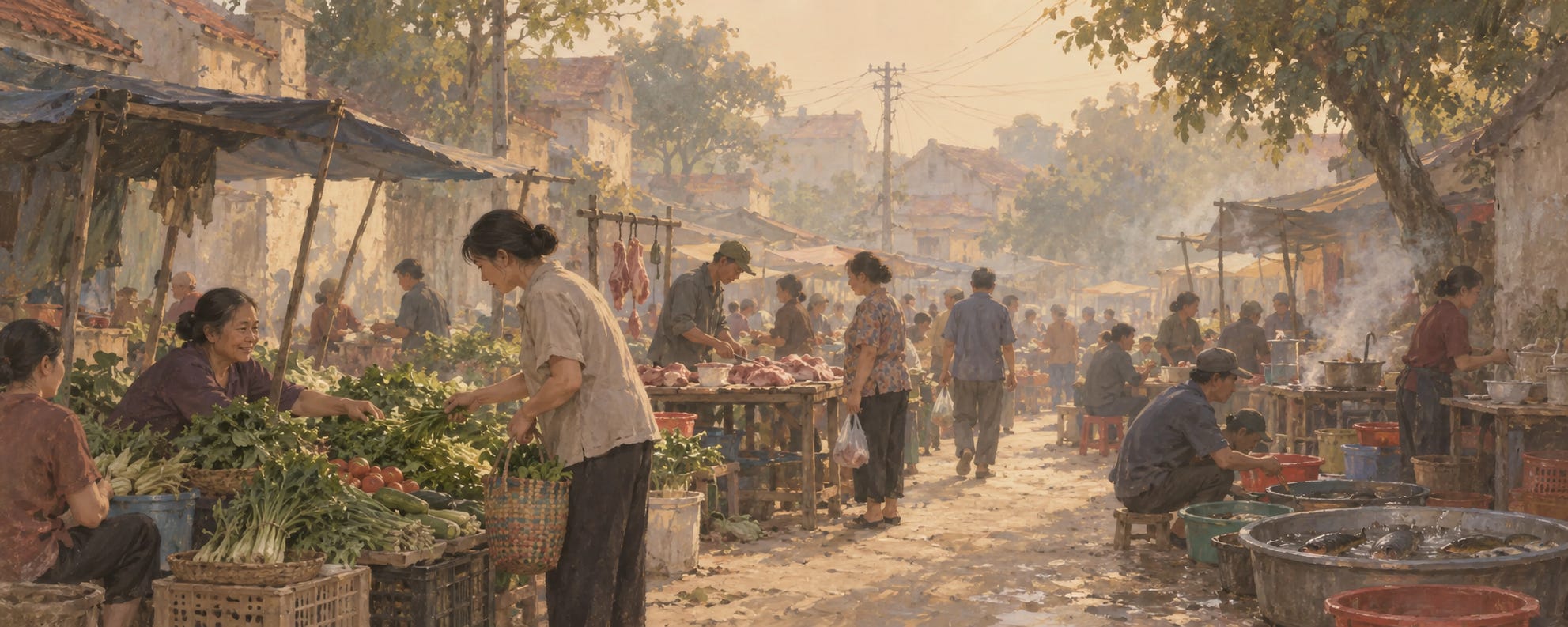
My own family was poor, but even when I was little, it was rare for us to have nothing to eat. The market in my village was packed every morning and afternoon. Families sold pork from pigs they had raised, vegetables from their gardens, and fish that were still alive at the stalls. People came early for the freshest food. By afternoon, smoke and the smell of food drifted through the market.
That was also Vietnam.
Growing up, I thought I knew exactly what success looked like.
Back then, hardly anyone in my village owned a car, and many houses were still small and worn down. Every now and then, someone who worked in the city would come back, build a big house, drive a car, dress neatly, carry a briefcase. People respected them. They were what people around me called successful, and I admired them too.
My mother would tell me to study hard so I could get a good job, do work that wasn’t so physically exhausting, have a chance to go beyond the village, and make the family proud.
I didn’t look down on my own family. Those words just sank in. Over time, I stopped thinking of that life as one version of success. It became success.
And reaching those things did matter. They made life easier in real ways, and I was proud of what I had built and of being able to give my family things we hadn’t had before.
But once I had the things I used to admire from far away, they became much more ordinary. I had everything I once thought I wanted, and I still felt something was missing. I wasn’t as happy as I had imagined I would be.
None of these pictures were false. They just weren’t the whole picture.
Sometimes a picture becomes more than something I see. It becomes the standard I use to judge my own life.
After I shared a shorter version of this idea, a woman who had lived in Los Angeles for twenty years commented on the village market I described. She said it sounded like her version of success.
I kept thinking about that. I had left that market behind when I went out to see more of the world.
I still want to go out into the world. I still want to build things, grow, and see what else is possible.
I just don’t want one side of someone else’s life to tell me what mine should look like.
- Nam Le