
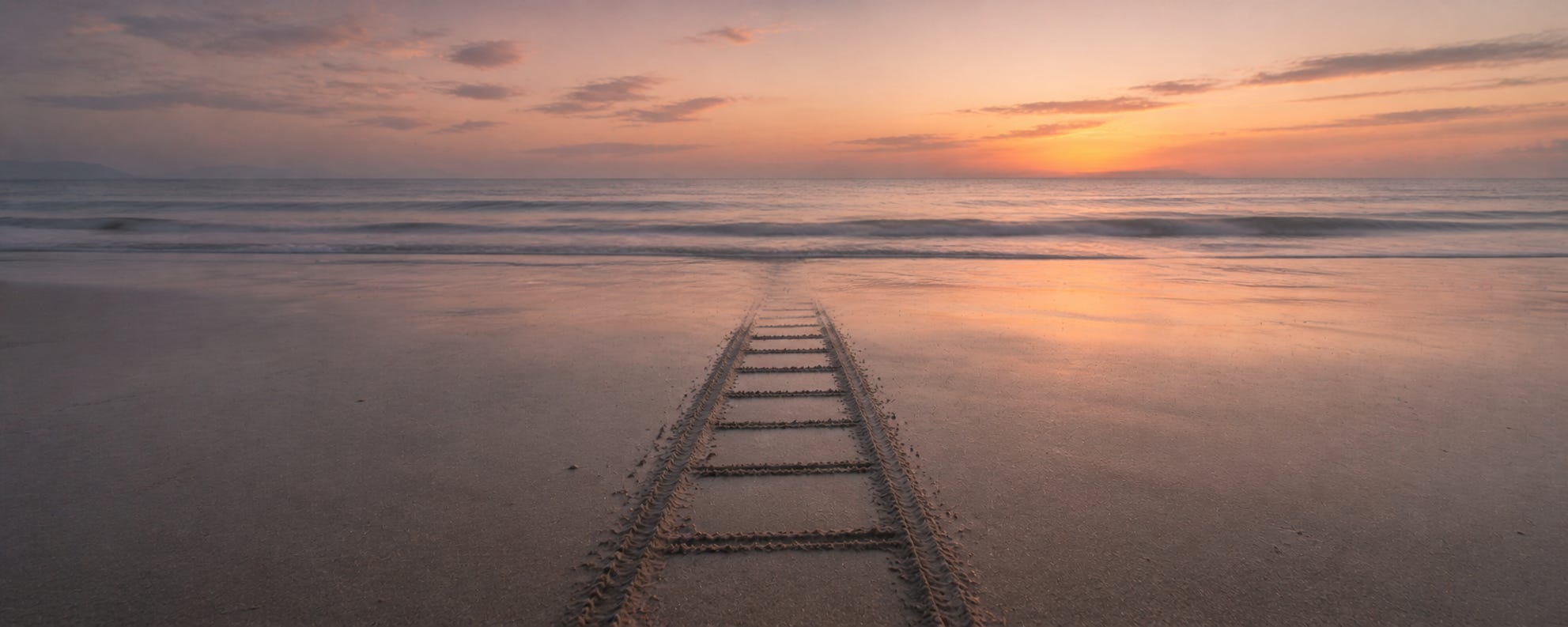
“I really admire you. You live in a beautiful apartment in a luxury high-rise. You travel the world. You’ve done things many people dream of doing. To me, that looks like a life well lived.”
A younger friend once said that to me over coffee.
I just smiled. Because the life he called “well lived” had started to feel foreign to me.
I knew exactly what he was seeing. It was the same thing I had wanted five years earlier: to escape a difficult, humiliating life and step into something freer.
At that moment, something small moved inside me. It was as if everything I had achieved did not make me feel as proud or as happy as it looked from the outside. But I just smiled and let it pass.
I did not know how to tell him that I had once thought this was the life I wanted. But now I felt tired, lost, and unsure what I actually wanted anymore.
I wanted to open myself up and let him see the wounds I had carried through the whole journey. That was the real story. That was the part below the surface. The glow was only the performance, the part people could easily see.
But at that time, I could not do that.
Later, I realized I had smiled that same smile many times. Every time someone praised me for a life I was no longer sure I wanted to live, I smiled. No disagreement. No explanation.
I used to think that smile was maturity. Humility.
But now I understand that sometimes an awkward smile is a very small sign of a very large gap: between what people see from the outside, and what you actually feel inside.
That was when I began to realize that maybe I had not been living a life of my own. Maybe I was only living a life many other people would call well lived.
I used to think my life was measured by the peaks I climbed, the achievements I collected, and the praise that made people want to learn from me.
But later, I started to ask myself: if no one was watching, if no one was praising me, if there was no reward waiting at the end, would I still want to live that life?
It took me a long time to even begin answering that question.
Through two ladders, one collapse, and one mountain.
THE MONEY LADDER
At 25, I thought I had reached the answer.
I rebuilt a new house for my family. I enrolled in expensive programs I could only look at from a distance before. And for the first time, I felt like I had gone far enough from the poor, humiliated version of myself I used to be.
I had spent almost all of my early youth climbing that ladder. The ladder of money.
Because deep down, I believed that if I made enough money, I would no longer have to feel small and unsafe.
That same year, Covid became serious. I had to isolate at home, alone with four walls. Work was still running. Money was still coming in every month.
But when all the noise outside stopped, I began to hear something I had avoided for a long time. When I was busy making money, I did not have to look at it. When I could still go out, meet friends, and work, I could temporarily forget it.
But in that room, there was nowhere left to hide.
A heavy, dull, gloomy boredom began to rise. Not the kind of boredom that comes from having nothing to do, but the feeling of an old part of me that had never been listened to, never been understood, and never really been touched.
My body had grown up. But the child was still there.
And after years of being ignored, it started to scream like a starving animal.
At that time, I did not know how to name what was happening. I only knew there was a deep part of me that money could not reach.
So I started to turn inward more often, to understand the part inside me I had ignored for too long.
Only later did I understand: money did not fail because it was meaningless. Money failed because it was answering the wrong question. The 21-year-old version of me was not really asking, “How do I become rich?” He was asking, “How do I finally feel safe?”
Money looks like the answer until you sit alone in a quiet room with wounds that have not healed.
When money was no longer enough, I did what many people do. I went looking for another ladder. A ladder that seemed deeper, more human, and more worthy of pride.
But in the end, it was still a ladder.
THE RECOGNITION LADDER
One time, in a business class, my mentor asked the whole room, “Who here has a marathon medal? Please stand up.”
At that time, I did not have one. I did not even understand what running a marathon really required. I could not stand up like some of the others. But inside, I felt lesser. So I signed up for a marathon too.
Another time, he asked the room, “Who here has an Ironman medal? Please stand up.”
Only a few people did. And I wanted even more to belong to that small group. To stand out. To be valued. To be seen differently. So I signed up for an Ironman too.
I am not saying my mentor encouraged people to chase recognition. His point was that marathon training builds discipline and willpower, things that are very important for an entrepreneur. That is a good reason to run a marathon.
But at that time, “discipline” was a very distant concept to me. “Medal,” “standing up,” “being seen” — those felt much closer.
I wanted to feel proud that I had a medal too.
He said Ironman was a three-sport race, a way to train business strategy. But I heard something else: if I could do it, people would value me more. They would see me differently.
Same lesson. Same teacher. Other people heard one thing. I heard another.
What I heard depended on what I was hungry for.
And I trained like a machine.
During each run, I was not really listening to my body. I only looked at my pace, my training plan, the distance still missing, as if each kilometer was another piece of proof that I was moving closer to a version of myself worthy of recognition.
In other advanced classes, I was also very active. I hosted. I raised my hand to share. I passed the microphone around. I helped people.
At the end of one class, everyone went out to celebrate. I ate with them for a while, then quietly went upstairs. I watched everyone laughing, dancing, drinking beer.
I looked at them.
I looked at the ocean.
At that time, I did not know what to call that feeling. I only knew the party below was not where I belonged. And I did not know where I belonged either.
I could have climbed that ladder for another ten years.
Then November 2022 came.
THE COLLAPSE
On November 11, 2022, I was invited for the first time to speak for 30 minutes on stage at a large Internet Marketing event in Vietnam.
That afternoon, I received the news that the crypto exchange FTX had collapsed. It was the source behind 80% of my monthly income.
I was stunned for a long time. I could not believe what I was seeing and hearing. How could one of the biggest exchanges in the world collapse?
It was too big to fail.
My presentation was coming soon. I had prepared carefully. And even though it was my first time speaking on stage, I felt quite confident.
But from the moment I heard that FTX had collapsed, I felt something inside me begin to fall.
Not just my income.
But the credit that made me feel I had the right to stand on that stage that day. Before that, I had a result to lean on. A story to tell. Something that made me feel that what I was about to say was real.
But if the thing behind that result had just collapsed, then who was I standing on that stage as?
Were the things I had prepared still true? Or was I just bullshitting?
My mentor began introducing my presentation, and I froze even more. My heart was beating fast, like a drum before battle. I did not know what to say anymore. I felt like a person who had lost his soul. I knew I had to wake myself up, but I did not know how.
That day, instead of introducing me for two to five minutes, my mentor spoke for almost twenty minutes. I stood there, dazed, for what felt like forever.
Finally, I decided to run outside to the restroom. In those few minutes, I tried to pull myself back. Inside, I was still falling. But outside, I still had to walk onto that stage and perform a steady version of myself.
And I did.
I came back. I regained my confidence. The talk went well.
From the outside, everything seemed fine. But inside, something had cracked.
I thought that was the collapse.
It turned out to be only the surface collapse.
After that, I rushed to try almost everything I could to rebuild my income.
I studied more. I tried new business models. I started again in different directions. Every time I began, I thought: maybe this is the new path. Maybe this time I can make a lot of money again, without going back to the old work I no longer liked.
But after a while, I would stop again.
Not because those models did not work. But because the deeper I went, the more I realized I did not actually want to live the kind of life those models required.
From the outside, it looked like I was constantly searching for a new job.
But in reality, I was trying to rebuild a new identity: someone who could still make a lot of money, still feel proud of himself, but no longer have to be my old self.
I thought that meant I had left the money ladder.
But really, I was only looking for another ladder to climb back to the same place.
The surface was different. But underneath, it was still the same old question: how do I feel safe again, valuable again, and avoid facing the emptiness inside?
There were periods when I tried to force myself to be more disciplined. Do a little more. Endure a little more. I told myself that once I got results, everything would become easier and more enjoyable.
But the more I pushed, the more I felt something was not right.
It was not the kind of boredom that comes from hard work. It was the feeling that I was using discipline to keep myself inside a life that no longer felt like mine.
Until one day, I began to ask myself: why do I have to choose to live like this?
If I made money from this, would I be happier?
The answer was no.
I had made a lot of money before. I knew money could bring temporary joy. But it could not answer the question for me: how do I actually want to live?
Then I asked myself another question: if I do not live like this, then how do I live?
And I truly did not know.
Because the second question had no answer yet, the first one had not fully collapsed.
Every day, I kept forcing myself to continue. I thought: just endure a little longer.
At the beginning of 2026, I finally saw something I had not been able to see for the past three years.
At first, I thought it was just the boredom of a job that did not fit. But the longer I lived inside it, the more I realized that feeling was frighteningly familiar.
From childhood until I was 18, I had lived in boredom. But back then, I had no other choice. I did not know what else to do. No one saved me. And I did not know how to save myself.
At 29, after almost a year of living with that feeling day after day, I finally realized: I was no longer that poor, timid, humiliated 15-year-old boy.
I could choose differently.
And live differently.
That was when the real collapse happened.
Not when the money collapsed.
But when the belief, “I have no other choice,” collapsed.
But realizing I could choose differently was one thing. Knowing what to choose was another.
I still did not know what was truly mine.
I only knew it had to begin with something no longer chosen for other people’s eyes.
Something without an audience. Something that, even if no one forced me, even if no one clapped, I would still want to come back to every day.
THE MOUNTAIN
13:59:47.
I crossed the finish line with only 13 seconds left before the 14-hour cutoff.
Not 13 minutes. 13 seconds.
50 miles of trail. Alone in the mountains of America. No audience. No reward except finishing.
This was one of the first things I chose after stepping down from the old ladders. No one told me I had to run. No one would know if I quit halfway.
This time, there was no one left to prove anything to.
Just me and the thing I had chosen.
Before the race, I thought I would finish in around 11 or 12 hours. I had run many marathons. I had just finished a 50K trail race and felt strong.
I thought I could just keep the old strategy: walk the uphills, run the downhills.
But this race did not go the way I imagined.
Both calves tightened from the beginning.
At kilometer 30, both feet were blistered and aching.
At kilometer 40, I looked at my watch.
7 hours.
I had used half the time for half the distance.
And for the first time in this race, I began to seriously think about the possibility of… not finishing.
For the first time in my life during a race, I started asking other runners, “What is the cutoff for the next aid station?”
Before that, I was still running inside my plan. From that point on, I had to start running inside the reality of the race.
The sky began to get dark.
And right then, I realized I did not have my headlamp.
The forest trail became completely dark. My eyesight was poor. All I had left was the flashlight on my phone to light the path in front of me, one small section at a time.
The clock kept counting down.
20 minutes.
10 minutes.
I could hear the cheering at the finish line, but I still could not see where it was.
Then I heard someone shout, “One minute left!”
At that moment, I had nothing left to save.
I ran down the final stretch.
13:59:47.
One of the last three people to finish the race.
While I was still on the trail, I thought I had almost paid the price for being too relaxed.
But after I calmed down and looked back, I understood that the story was not that simple.
I had been trying the whole time. I had still walked the uphills and run the downhills, the same strategy that had helped me in previous races.
But this time, my body was different. The course was different.
What almost cost me the race was not simply that I was too relaxed. It was that I had kept using an old plan after reality had changed.
On the trail, it took me almost 14 hours to realize that.
In life, it took me three years.
The mountain did not teach me that I had to be more stubborn.
The mountain taught me that if something is my choice, I have to truly be present with it.
But being present does not mean holding tightly to an old plan.
Being present means looking directly at the reality in front of me, changing rhythm when needed, and continuing to move.
BEFORE IT IS TOO LATE
I am still walking on another mountain of my own.
There are parts that are still unclear. There are days when I am still not sure if I am walking in the right direction.
But after the old ladders, after one collapse, and after a real mountain, I have started to believe one thing more deeply.
If something inside you has been quietly saying that the way you are living no longer feels right, listen to it sooner.
Because the cost often does not arrive as one big pain. It arrives quietly. You get used to a rhythm that no longer makes you feel alive. And then one day, continuing becomes easier than stopping, even though continuing is the very thing that is slowly wearing you down.
From the outside, everything looks fine. Inside, you have been tired for a long time.
A life well lived is not the kind of life that makes other people look at it with admiration.
It is the kind of life where, when someone calls it well lived, I no longer have to smile an awkward smile to hide the gap inside.
Not because I know the whole road ahead.
But because, this time,
I no longer want to look past the quiet misalignment inside me.
- Nam
Chị cũng từng nghe câu hỏi đó, nhưng chị đã chọn không đứng lên, lặng lẽ đăng ký Coaching IM của thầy, và lặng lẽ chọn dừng lại khi không còn thấy phù hợp với mình.